AC Short Cycling in Santa Clarita, CA
The direct answer: When a Mitsubishi system short-cycles in Santa Clarita, Santa Clarita Mitsubishi HVAC traces it to oversizing, a dirty filter or coil starving airflow, low refrigerant, or a protection fault - across Valencia (91355), Saugus (91350), and Canyon Country (91387) - so call (213) 766-5980 or book online. An inverter is built to run steadily, so hard cycling always has a cause worth diagnosing.
Snapshot
- Inverter heat pumps are designed to modulate and run steadily - hard cycling means something is forcing it off.
- Top causes: oversized equipment, dirty filter/coil (P6 freezing protection), low refrigerant (P8/U7), failing capacitor.
- Oversizing is common in SCV tract homes where builder tonnage was a rule-of-thumb guess.
- Short-cycling wears the compressor and inverter board and raises your bill.
- A Manual J load check settles whether the system is just plain too big for the space.
- Service ZIPs: 91350, 91351, 91354, 91355, 91387, 91390. Hours: Weekdays 8am-7pm, weekends 9am-4pm.
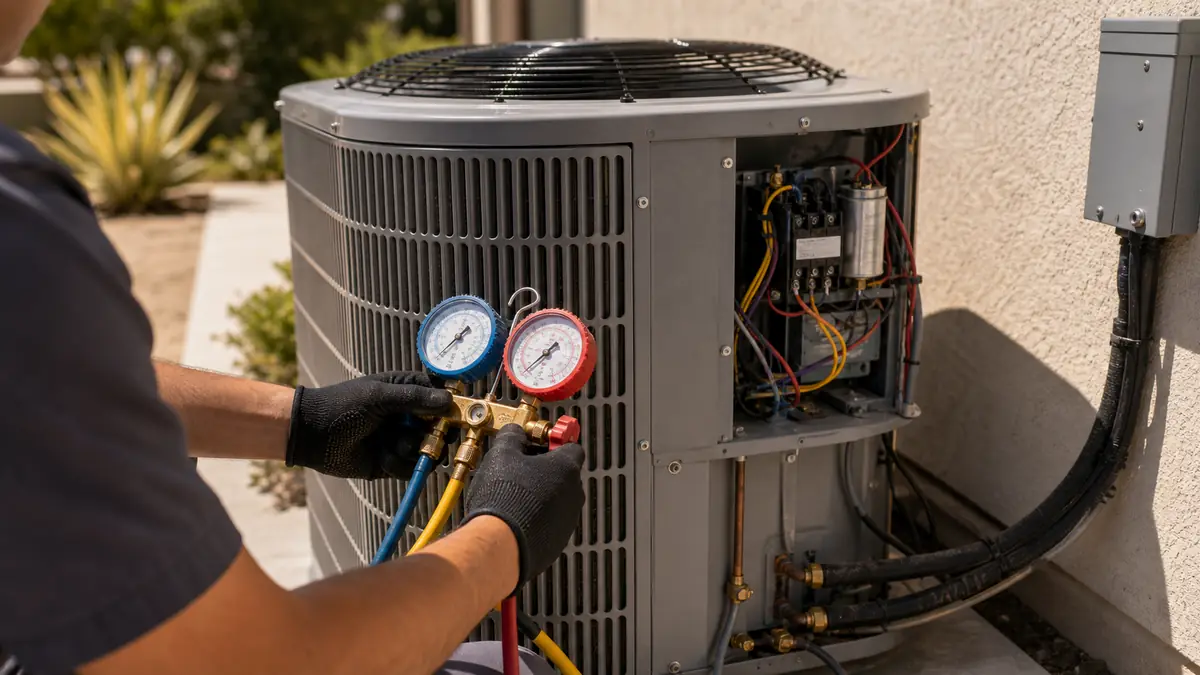
What does short-cycling mean on an inverter system?
Short-cycling is when the system turns on, runs briefly, shuts off, and repeats every few minutes instead of settling into a steady run. On an old single-stage AC that was somewhat expected. On a Mitsubishi inverter heat pump it is a red flag, because the whole point of inverter technology is to modulate and run long, gentle cycles. So when an inverter cycles hard, something is actively forcing it off - a protection trip, a charge problem, or equipment that is simply too big for the load. It is not just annoying; it wears the compressor and inverter PCB you do not want to replace.
Why would my Santa Clarita AC be cycling on and off?
Four common causes here. Oversizing - if a prior installer put in too much tonnage, it cools the air fast, hits setpoint, and shuts off before a real cycle, which is common in tract homes where the original sizing was a guess. Restricted airflow - a dirty filter or coil drops airflow, ices the indoor coil, and trips a P6 freezing protection. Low refrigerant - a flare-joint leak makes the system trip low-pressure or pipe-temp protection (P8, U7), cut off, then restart. And a marginal capacitor that cannot keep the compressor running under SCV afternoon load. We diagnose which one rather than just resetting it.
| Pattern / code | Likely cause / first check | Cost lane |
|---|---|---|
| Cools fast then quits, repeats | Oversized equipment; Manual J check | $95 - $350 diagnosis |
| Ices up then trips, P6 | Dirty filter or coil, airflow restriction | $95 - $350 |
| Off then restarts, P8 / U7 | Low refrigerant, flare-joint leak | $225 - $1,500 |
| Compressor cuts out under load | Weak run capacitor | $150 - $450 |
How does a tech diagnose short-cycling in order?
The walkthrough runs cheapest-and-most-common to most-expensive, because skipping straight to refrigerant gauges on a unit that just has a clogged filter wastes your money. First, confirm the pattern: a stopwatch on the cycles tells us whether it is true short-cycling (on for two to five minutes, off, repeat) or a thermostat reading the wrong temperature. Second, pull the filter and inspect the indoor coil - a starved coil ices, the head trips a P6 freezing/overheating protection, and the system cuts out until it thaws. Third, read the green-LED blink and the P/E/U code on the wired controller or kumo app: P6 points at airflow, P8 (abnormal pipe temperature) and U7 (low discharge superheat) point at a refrigerant leak, and U2/U6 point at a discharge-temp or compressor-overcurrent trip. Fourth, put gauges on the line set and check superheat and subcooling against the nameplate charge - low charge from a flare-joint leak is a classic cycle-on-protection cause. Fifth, meter the run capacitor under load; a capacitor that has dropped microfarads lets the compressor stall and kick out on a 102 F Saugus afternoon. Only after those clear do we weigh oversizing, which a Manual J confirms.
Which short-cycling checks are safe for me, and which need a pro?
Safe to do yourself: swap the air filter, clear leaves and debris off the outdoor MUZ condenser, make sure no return vents or supply registers are blocked by furniture, and confirm the thermostat is not in direct sun or next to a heat source that fools it. Those handle the airflow-driven cycle, which is the most common and the cheapest. Stop there and call a tech for anything past that - reading refrigerant pressures, loading a capacitor to meter it, exercising the LEV/EEV, or settling whether the equipment is simply oversized. That work leans on gauges, a meter, and the unit's stored code history, and an oversizing verdict in particular rides on a load calculation rather than a parts swap. Repeatedly resetting the breaker on a unit that keeps cycling can damage the inverter board, so leave it off and book the visit.
What does fixing short-cycling cost in Santa Clarita?
It tracks the cause. An airflow fix - filter and a coil cleaning that clears a P6 - usually rides inside a $95-$350 diagnostic-and-service visit. A weak run capacitor that lets the compressor stall runs $150-$450 installed, the cheapest real part fix in this valley. A refrigerant leak behind a P8 or U7 means leak search, seal, and recharge to nameplate weight at $225-$1,500 depending on where the flare joint failed and how much charge walked out. If the code is U2/U6 and the inverter board or compressor is the root, you are in $400-$3,500 territory and the repair-or-replace math enters. And when the diagnosis is oversizing, no part swap touches it - the cure is a right-sized replacement, $3,500-$8,000 for a single-zone MSZ/MUZ and up from there.
Can I fix short-cycling myself?
You can do the cheapest first step: replace a dirty filter and make sure return vents and the outdoor unit are not blocked. If a clogged filter iced the coil, clearing it and letting the coil thaw often breaks the cycle. Beyond that - charge, capacitor, and especially oversizing - needs a tech. When oversizing is the root cause, no part swap touches it; the fix is right-sizing at replacement, which is exactly where a Manual J load comes in.
What if the cause is oversizing?
Then patching parts is throwing money away. An oversized system in a Santa Clarita home will keep short-cycling no matter how many capacitors you replace, because the equipment is fighting physics. The fix is a properly sized replacement - see AC installation and the repair-or-replace briefing. If it is cycling because it cannot cool at all, start with AC not cooling.
Common questions
Is short-cycling bad for my Mitsubishi system?
Yes. Constant start-stop cycling wears the compressor and inverter board, spikes your bill, and never lets the system pull humidity or reach setpoint evenly. An inverter heat pump is built to modulate and run steadily, so if it is cycling hard, something is forcing it off - that is worth fixing before the part it stresses fails.
Can an oversized AC cause short-cycling in my Valencia home?
It can. An oversized system - the kind a previous installer leaves behind - chills the air quickly, trips the thermostat, and cuts off before finishing a cycle, then does it all over again. You see this wherever builder tonnage was a rule-of-thumb guess. A Manual J load check is what tells us whether the equipment is flat-out too big for the space.
Why does my unit cycle off then ice up?
Restricted airflow. A dirty filter or coil drops airflow over the indoor coil, which lowers coil temperature until it ices and the system trips a P6 freezing protection - off, thaw, on, repeat. Clearing the filter and coil usually breaks the cycle; if it returns, we check refrigerant charge and the blower.
Could low refrigerant make it short-cycle?
Yes. Low charge from a flare-joint leak makes the system trip its low-pressure or pipe-temp protection, cut off, then restart once pressures recover - a short cycle. You will often see a P8 or U7 code. We leak-search and recharge to the nameplate weight rather than masking it with a top-off.
Last updated 2026-06-13.