Heat Pump Repair in Santa Clarita, CA
The direct answer: Santa Clarita Mitsubishi HVAC repairs Mitsubishi Electric heat pumps across Santa Clarita, Valencia (91355), and Canyon Country (91387) - so call (213) 766-5980 or book online. We fix reversing-valve, EEV, inverter-board, thermistor, and defrost faults on M-Series MUZ/MXZ and P-Series PUZ units, reading the U-code and quoting on site, most repairs between $150 and $3,500.
Snapshot
- Inverter heat pumps fail more on boards and sensors than on brute mechanical parts.
- Inverter PCB / control board: $400-$2,000; inverter DC compressor: $1,200-$3,500 (much less if in warranty, labor only).
- Common codes: U6 (compressor overcurrent/inverter), U2 (high discharge temp), U7 (low refrigerant), P8 (pipe temp / leak).
- We read EEV position, thermistor values, and inverter status, not just swap parts.
- Service ZIPs: 91350, 91351, 91354, 91355, 91387, 91390. Hours: Weekdays 8am-7pm, weekends 9am-4pm.
- In-warranty Mitsubishi heat pumps referred to authorized service first.
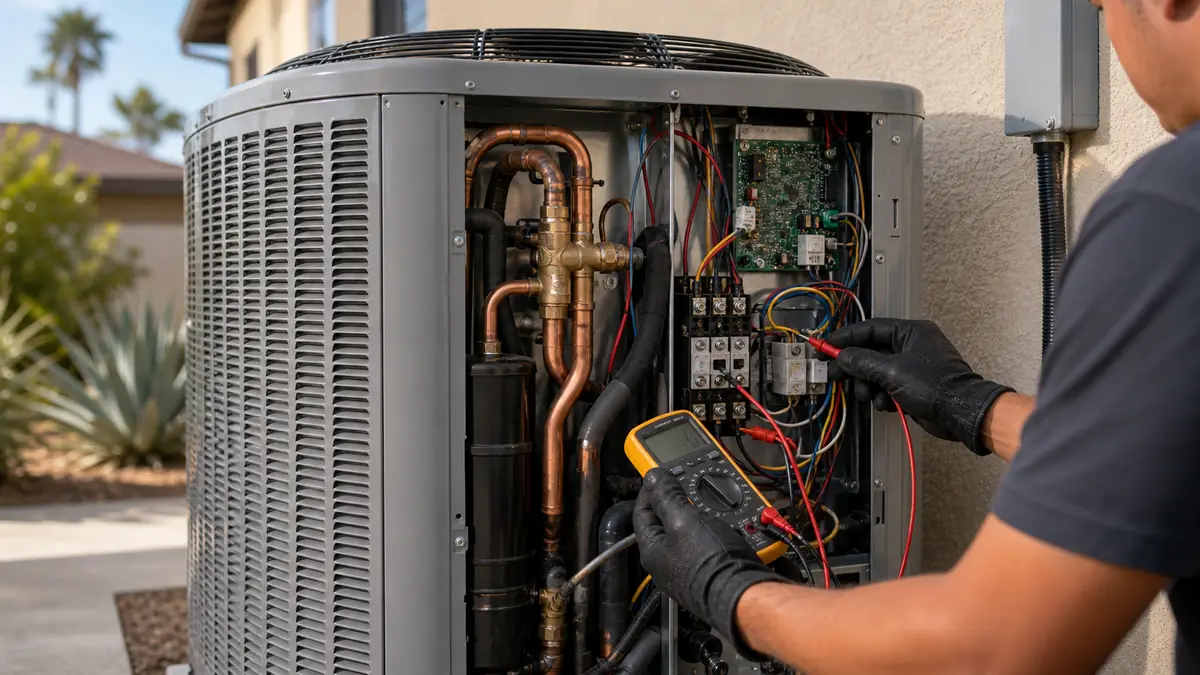
Why is my Santa Clarita heat pump not heating or cooling right?
Mitsubishi heat pumps run in both directions through a reversing valve, so a fault can show up in only one mode. A unit that cools fine but heats weakly points at the reversing valve, a defrost problem, or low charge that only matters under heating load. A unit weak in both directions is usually low refrigerant or a sticking LEV/EEV (the electronic expansion valve that meters refrigerant). Because these are inverter machines, the failures skew toward control boards, thermistors, and the inverter/IPM rather than the simple capacitor-and-contactor faults of old single-stage equipment - though those still happen.
The fault codes tell the story. U-codes cover the outdoor unit, compressor, and inverter: U2 high discharge temperature, U3 the discharge thermistor, U5 the inverter heatsink, U6 compressor overcurrent, U8 the outdoor DC fan motor, U9 over/undervoltage. P8 is an abnormal pipe temperature that often means a flare-joint refrigerant leak, and U7 is low discharge superheat from low charge. We read the green-LED blink and the controller or kumo code before condemning anything.
Is a U6 code always a dead compressor?
No, and this is where guessing gets expensive. U6 (compressor overcurrent / inverter) can be a failing compressor, but it can equally be the inverter PCB or IPM mis-sensing current, a wiring fault, or a power problem. The price gap is enormous - a board runs $400-$2,000, a Mitsubishi inverter DC compressor $1,200-$3,500 - so we verify which part actually failed with meter readings and the inverter diagnostics, not a parts-swap roulette. If another shop quoted you a compressor on a U6, that is a good reason to get a second opinion.
| Symptom / code | Likely cause / first check | Cost lane |
|---|---|---|
| Cools fine, weak heat | Reversing valve solenoid or defrost fault | $300 - $1,200 |
| Weak both modes, frost, U7 / P8 | Low refrigerant (flare leak) or sticking LEV/EEV | $225 - $1,500 |
| Trips on startup, U6 / U2 / U5 | Inverter PCB / IPM, then DC compressor | $400 - $3,500 |
| Outdoor fan dead, U8 | Outdoor DC fan motor | $300 - $900 |
| Comfort drift, P1 / P2 / P9 | Room or pipe thermistor (TH1/TH2/TH5) | $150 - $450 |
| Water under indoor head, P4 / P5 | Condensate drain or drain pump fault | $95 - $450 |
| Dropouts, E6-E9 / EA / EB | Loose S1/S2/S3 inter-unit wiring or board | $150 - $2,000 |
How does a Mitsubishi heat pump repair visit go?
The sequence is built to avoid condemning a good compressor. First we read the fault before opening anything - the indoor green-LED blink count plus the U/P/E code on the wired controller or kumo app, since a U6 and a P8 send us in opposite directions. Second, mode testing: we run the unit in both heating and cooling and watch where it falls down, because a reversing-valve fault hides until you call for the mode it cannot switch into. Third, the meter work - thermistor resistance against the spec curve (TH1 intake, TH2 liquid pipe, TH5 coil), EEV/LEV coil continuity and commanded versus actual position, inverter and IPM status, and compressor and fan amp draw under load. Fourth, the refrigerant side when U7 or P8 shows: gauges, superheat and subcool, and a leak search along the flare joints. Fifth, the fix and verification - swap the failed part, recharge to nameplate weight if we opened the circuit, restart, and confirm the unit ramps cleanly and clears the code in both modes.
Which Mitsubishi heat pump lines does this cover?
The single-zone M-Series MUZ condensers (MUZ-WR, MUZ-HM, MUZ-FS, and the Hyper-Heat MUZ-FS..NAH / MUZ-FX..NLHZ), the multi-zone MXZ and MXZ-SM SMART MULTI outdoor units, and the larger P-Series PUZ on PEAD or PVA air handlers. What changes by line is mostly the board and the refrigerant. Inverter PCBs differ between M-Series and P-Series, Hyper-Heat units add cold-climate defrost logic that a standard MUZ does not run, and the newest single-zone ducted P-Series (PUZ-AK..NLHZ with PEAD-AA..NL) uses R-454B instead of the R-410A in legacy M-Series, which changes our recovery and recharge handling. A multi-zone MXZ-SM also branches refrigerant to several heads, so a fault on one zone can trace back to a branch-box or a single head's EEV rather than the condenser.
What does a heat pump repair cost in Santa Clarita?
The diagnostic runs in the low-$100s and is often credited toward the repair. From there: a thermistor is $150-$450, an outdoor DC fan motor $300-$900, a reversing-valve or defrost repair $300-$1,200, and a refrigerant leak repair plus recharge $225-$1,500 depending on where the leak sits and how much charge the system holds. The expensive forks are the inverter board at $400-$2,000 (the Mitsubishi PCB part alone is often $120-$800-plus) and the inverter DC compressor at $1,200-$3,500 - far less if the unit is still in its parts-and-labor warranty, where you pay labor only. That compressor number is what usually decides repair-versus-replace on an older condenser. SCV labor rates sit above the national average, which is why the trip and labor, not the part, drive a small repair's price.
Does the SCV climate stress heat pumps differently?
Yes - here the cooling side gets hammered, not the heating side. Being cooling-dominant Zone 9, Santa Clarita keeps a heat pump rejecting heat through most of its hours on 90 F-plus days, so that is where the wear turns up first. Hyper-Heat models built for sub-freezing climates are overkill for SCV winters; a standard inverter is the right call. If your heat pump is one of the newer single-zone ducted P-Series units, note it may use R-454B refrigerant rather than the R-410A in legacy M-Series gear, which changes how we handle a leak repair.
When should I stop repairing and replace?
Stick a compressor or inverter-board quote on a fifteen-year-old SCV condenser and the repair number lands at or above what half a new system costs, which is the clearest replace signal there is. The repair-or-replace briefing runs the numbers, and heat pump installation covers the rebate-eligible replacement path.
Common questions
My Mitsubishi heat pump cools fine but barely heats. What is wrong?
A heat pump that cools but not heats usually has a stuck reversing valve, a defrost-cycle problem, or low refrigerant that only shows up in heat mode. We check the reversing valve solenoid and the pipe thermistors first. In the mild SCV winter this is a comfort issue, not an emergency, but it is worth fixing before the next cold snap.
What does a U6 code mean on my MUZ outdoor unit?
U6 is a compressor overcurrent / inverter fault. It can be a genuine compressor problem, but just as often it is the inverter board or IPM sensing the fault. That distinction matters: a board is $400-$2,000 while an inverter compressor is $1,200-$3,500, so we confirm which one actually failed before quoting.
Can you repair the heat pump while it is still inverter-driven and quiet?
Yes. Inverter heat pumps fail differently than old single-stage units - more board and sensor faults, fewer brute mechanical ones. We carry the diagnostic tools to read the EEV position, thermistor values, and inverter status rather than just swapping parts and hoping.
Is my heat pump short-cycling a refrigerant problem?
It can be. Short-cycling on a Mitsubishi heat pump often traces to low charge from a flare leak, a sticking LEV/EEV, or restricted airflow from a dirty filter or coil. We diagnose the cause rather than just resetting it - see the short-cycling walk-through for the full checklist.
My outdoor unit steams or ices up in winter. Is it broken?
Usually not. A heat pump in heating mode runs a defrost cycle - it briefly reverses to melt frost off the outdoor coil, which throws steam and a puff of vapor. That is normal. It is only a fault if the coil stays caked in ice, the unit never recovers heat, or it throws a code. In the mild SCV winter true defrost faults are uncommon.
Can you fix one head on my multi-zone system without touching the others?
Often, yes. On an MXZ or MXZ-SM SMART MULTI system, a single head's weak airflow or comfort drift can trace to that head's EEV, thermistor, or branch connection rather than the shared condenser. We isolate the faulty zone and repair it, confirming the other heads and the outdoor unit are clear before we close out.
Last updated 2026-06-13.