Repair or Replace Your AC in Santa Clarita, CA
The direct answer: Santa Clarita Mitsubishi HVAC settles repair versus replace on an SCV home with two fast checks, and you can walk the math here, then call (213) 766-5980 or book online. Replace when the repair tops roughly half the cost of a new system on a unit already past 10-12 years; and replace when the unit's age times the repair cost clears about $5,000. Many original Valencia (91355) and Saugus (91350) condensers now fail both.
Snapshot
- Test one: a repair quoted above ~50% of a new system, on a unit already beyond 10-12 years, points to replace.
- Test two: the unit's age times the repair cost; once that product passes ~$5,000, replace.
- Clear repairs: capacitor ($150-$450), contactor ($150-$450), condensate drain ($95-$450).
- Replace-leaning repairs: compressor ($1,200-$3,500), inverter board ($400-$2,000), leaking coil.
- Many 1990s SCV tract condensers are now 25-35 years old - past the decision threshold.
- Replacing opens LADWP/SCE rebates a repair can never claim - confirm the current amounts.
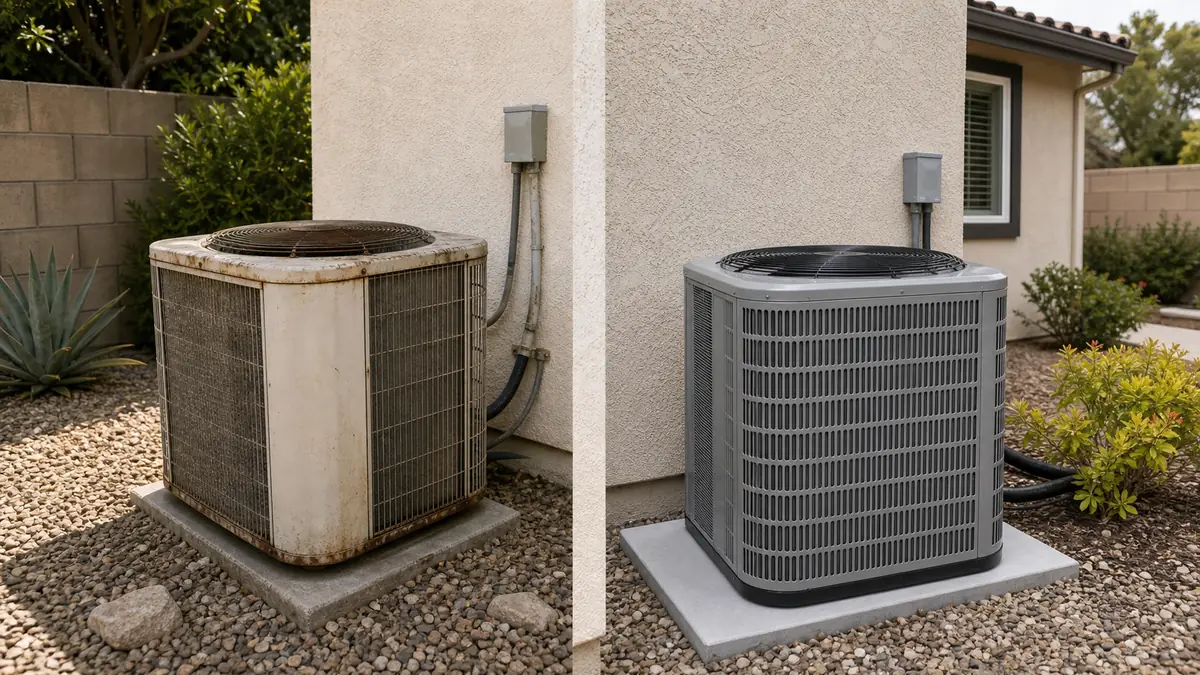
What are the two rules that actually decide it?
In the field it boils down to two rough tests, and they tend to agree. The first is the percentage check: once a repair costs more than about half of a comparable new system and the unit has already aged past 10-12 years, the money usually goes toward replacement. The second is the multiply check: take the unit's age in years, multiply it by the repair cost, and replace if the result tops roughly $5,000. Run a fifteen-year-old condenser facing an $1,800 inverter-board repair and you get 15 x 1,800 = $27,000, miles over the line. Run a six-year-old unit that needs a $300 capacitor and you get 6 x 300 = $1,800, plainly a repair. The tests are blunt on purpose - that bluntness is what keeps both sentiment and a sales pitch out of a four-figure decision.
Why does Santa Clarita push so many systems toward replacement?
Timing and heat. The SCV is a wall of master-planned tracts built from the late 1980s through the 2000s - Valencia Summit around 1985-1990, the 1990s Saugus and Canyon Country subdivisions, Tesoro del Valle in the 2000s. Those first systems are now 20-35 years old, which lands most of them on the wrong side of both rules the moment a major part fails. The valley's Zone 9 heat accelerates it: hundreds of hours a year over 90 F, plus 100 F-plus Santa Ana spikes, wear compressors and coils faster than a coastal climate would. So in Santa Clarita, a major repair on an original builder system is usually a replacement conversation, while a major repair on a coastal home of the same age might not be.
| Failed part / cost | Unit under 10 yr | Unit over 12-15 yr |
|---|---|---|
| Capacitor / contactor ($150-$450) | Repair | Repair |
| Condensate drain / pump ($95-$450) | Repair | Repair |
| Refrigerant leak + recharge ($225-$1,500) | Repair (find the leak) | Repair if minor, else weigh replace |
| Inverter / control board ($400-$2,000) | Usually repair | Usually replace |
| Compressor ($1,200-$3,500) | Weigh warranty vs replace | Replace |
When is repair clearly the right call?
When the failed part is a normal wear item on a system that still has years left. A run capacitor is the most common SCV failure precisely because heat is hard on it, and replacing one on a mid-life unit is a same-day, few-hundred-dollar fix - not a death sentence. The same goes for a contactor, a condensate drain or pump (a P4 or P5 fault), an outdoor fan motor, or a small, findable refrigerant leak that we seal and recharge to spec. If the system is under ten years old and the diagnosis is one of these, you repair it and move on; chasing efficiency by scrapping a healthy unit rarely pays back fast enough, even here.
When does replacement win even if repair is possible?
When the part is a compressor, an inverter board, or a leaking coil on an aging unit - and especially when two of those line up. A fifteen-year-old condenser that needs a $2,500 inverter compressor is not worth it: you would spend most of a new-system price to extend a unit that will hit its next major failure soon, with no efficiency gain and no rebate. Replacement also puts LADWP and SCE heat-pump rebates on the table that no repair can ever touch, which narrows the real cost gap. And if you are living with a system that short-cycles because someone oversized it, no part swap reaches that root problem - only a right-sized replacement cures it. The sizing briefing covers getting the next one right.
Three worked examples with the actual math
Numbers settle this faster than opinions. Case one - a 6-year-old MUZ condenser on a Tesoro del Valle home throws a U6 that turns out to be a $300 run capacitor. Percentage check: $300 is nowhere near half a new system, so repair. Multiply check: 6 x 300 = $1,800, well under $5,000. Both say repair, and it is a same-day fix. Case two - a 1998 Valencia central condenser needs a $2,500 compressor. Percentage check: a comparable new system runs $5,000-$12,000, and $2,500 is right around or above half on the value end, so the flag is up. Multiply check: at roughly 27 years old, 27 x 2,500 = $67,500, miles past $5,000. Both say replace, decisively. Case three - the genuinely tricky one. A 13-year-old Saugus condenser needs an $1,800 inverter board. Percentage: $1,800 is well under half a $6,000-plus replacement, leaning repair. Multiply: 13 x 1,800 = $23,400, leaning replace. When the two checks disagree, the tiebreakers are remaining warranty, the condition of the rest of the system, and whether a replacement unlocks a rebate the repair never can. On a unit that is otherwise sound with no other failing parts, that board repair can still be the smart spend; if the coil is also weeping or the compressor sounds tired, replacement wins.
| Scenario | Percentage check | Age x cost check | Verdict |
|---|---|---|---|
| 6 yr unit, $300 capacitor | Far below 50% | $1,800 | Repair |
| 27 yr unit, $2,500 compressor | At/above 50% | $67,500 | Replace |
| 13 yr unit, $1,800 board | Below 50% | $23,400 | Tiebreak (often replace) |
| 9 yr unit, $900 leak repair | Below 50% | $8,100 | Repair if leak is findable |
How long should a Santa Clarita system last anyway?
Less than the brochure promises, because the SCV runs its equipment hard. A central condenser nationally is often quoted at 15-20 years, but in Zone 9 heat - 55-75 days a year over 90 F and 100 F-plus Santa Ana spikes - the compressor and coil see far more peak-load hours than a coastal unit, so 12-16 years of real service is a fairer planning number here. Mitsubishi inverter equipment is built for steady modulation rather than the brutal on-off duty that wears a single-stage compressor, and a well-installed, correctly charged inverter heat pump can run long and reliably, but the inverter board and DC compressor are the expensive parts you least want to gamble on past the decade mark. The practical takeaway: once an SCV system is past about 12 years and a major part fails, the age side of both checks is already pushing you toward replacement before the repair quote even lands.
Does replacing open a heat-pump conversion worth doing?
Often, and it changes the math. When the failed unit is a straight AC paired with an aging gas furnace, replacement is the moment to weigh a Mitsubishi inverter heat pump that cools identically and then covers the mild SCV winter, letting the furnace retire. That conversion is what unlocks LADWP and SCE electrification rebates - reported as high as roughly $2,500 per ton at LADWP and near $1,000 per system at SCE, both of which you must confirm are still funded the week you sign - and a repair on the old unit captures none of it. So a replace verdict is not just "buy the same thing again." It is the decision point for whether to electrify, which is also where the California Energy Code keeps nudging Zone 9 homes. The buying guide walks the system choice and the heat pump installation page covers the conversion path.
What does an honest diagnosis include?
The unit's real age from the data-plate serial, the exact failed part confirmed by reading the Mitsubishi P/E/U code or the furnace flash code (not a guess), the firm repair price in writing, and a replacement quote with the rebate options when the rules say replace. We will tell you when the cheaper repair is the smart move even though a sale is on the table - because a U6 that turns out to be a board, not a compressor, can swing the whole decision. Start a diagnosis from AC not cooling or AC repair; if it is replacement time, see AC installation and the buying guide.
When should I time the replacement, given SCV heat?
If the checks say replace and the system is still limping, the smart move is to plan the swap for the shoulder season - spring or fall - rather than waiting for the unit to die during a July Santa Ana spike when every shop in the valley is buried and you are choosing under duress. A correctly run replacement on a master-planned tract home is not a same-afternoon job: it involves a Manual J load, equipment ordering, a permit, and the Zone 9 HERS refrigerant-charge and airflow verification, so a few days of lead time is normal. Replacing on your schedule also leaves room to weigh the rebate and heat-pump-conversion options properly instead of grabbing whatever is in stock. The exception is a unit that has already failed in a heat emergency, where comfort and safety override timing and a fast right-sized replacement beats nursing a dead condenser through another 102 F afternoon.
The bottom line for a Santa Clarita homeowner
- Run both checks: repair past ~50% of a new system on a 10-12-year-old unit, or age times repair cost over ~$5,000, points to replace.
- Wear parts on a mid-life unit - capacitor, contactor, condensate drain, small findable leak - are clear repairs.
- Compressor, inverter board, or a leaking coil on an aging condenser usually tips to replacement.
- Plan around 12-16 years of real SCV service life, not the 15-20 the brochure quotes for milder climates.
- If the verdict is replace and you run a gas furnace, weigh a heat-pump conversion for the rebate dollars a repair can never claim.
- Get the failed part confirmed by code and the price in writing before you decide - never on a phone guess.
Common questions
My 1998 Valencia condenser needs a compressor. Repair or replace?
Replace, about as close to certain as these calls get. A 25-year-old condenser facing a $1,200-$3,500 compressor fails both yardsticks at once: the repair runs well past half a new system's price, and the unit's age multiplied by the repair cost blows past $5,000. Put that money toward a right-sized, rebate-eligible replacement and you finish ahead.
Is it ever worth replacing a healthy AC just for efficiency?
Now and then, but keep your guard up. A working unit under ten years old seldom pays back an efficiency-only swap quickly enough, even in a valley this cooling-heavy. What flips the math is doing it alongside something else - converting to a heat pump for the rebates, or retiring a gas furnace that keeps letting you down.
How do I know my system's real age?
Read the serial number on the data plate - most manufacturers encode the year. A Mitsubishi or central condenser installed when a Saugus tract was built tells you the home's age too. If you cannot find it, we read it on the diagnostic visit; age is half the repair-or-replace decision.
Does a single capacitor failure mean my AC is dying?
No. A capacitor is a normal wear part, cheap to replace, and common in SCV heat. One capacitor on an otherwise-sound, mid-life system is a clear repair. Replacement only enters the picture when the failing part is a compressor, inverter board, or a leaking coil on an older unit.
Last updated 2026-06-13. Cost bands are approximate 2026 SoCal ranges; verify with an on-site quote.