Mitsubishi U6 Code in Santa Clarita, CA
The direct answer: A Mitsubishi U6 in Santa Clarita, CA (ZIP 91350) means the inverter sensed compressor overcurrent and shut the outdoor unit down to protect it - a failing compressor, an inverter/IPM power-board fault, or a heat-and-airflow overload. Stop restarting it, then call (213) 766-5980 or book online and we meter it before quoting a part.
Snapshot
- U6 = compressor overcurrent sensed by the inverter on the outdoor unit - a protection trip, not a guaranteed compressor failure.
- Three root causes: inverter/IPM power board, the DC inverter compressor itself, or an outdoor fan/airflow problem driving current up.
- Cost splits hard: inverter board $400 to $2,000; a compressor $1,200 to $3,500.
- SCV afternoons over 100 F raise head pressure and current, so U6 often fires only at the day's peak heat.
- Repeated forced restarts after a U6 can push a board fault into a compressor failure - leave it off.
- Service ZIPs: 91350, 91351, 91354, 91355, 91387, 91390. Hours: Weekdays 8am-7pm, weekends 9am-4pm.
What does the U6 code mean on a Mitsubishi?
U6 is an outdoor-side, inverter-level protection code. The inverter board drives the DC compressor by switching high-current power through its IPM (intelligent power module). It watches the current it is delivering, and when that current crosses the overcurrent threshold the board cuts the compressor and posts U6 rather than letting the current keep climbing. So U6 is a symptom of "too much current through the compressor circuit," not a diagnosis of which part caused it. That is the trap with this code: people read U6, assume the compressor is dead, and brace for the biggest bill in the system. Sometimes it is the compressor. Just as often it is the IPM board itself misreading or failing to drive cleanly, or something mechanical - a seized outdoor fan, a coil packed with cottonwood and high-desert dust - forcing the compressor to pull more amps than it should. The reading is real; the cause has to be proven.
Why does a Mitsubishi U6 happen in Santa Clarita homes?
This valley loads a compressor harder than the basin does. Santa Clarita sits above the LA flats with hotter, drier summers, and on a 104 F Saugus afternoon the air the condenser is trying to reject heat into is already brutal. High outdoor temperature raises condensing pressure, which raises the current the compressor draws - so a compressor or board that is even slightly marginal trips U6 at the day's peak and recovers by evening. The local housing stock makes it worse. In master-planned tract neighborhoods like Valencia and Stevenson Ranch-adjacent, condensers get crammed into narrow zero-lot-line side yards with a fence a couple feet away, so hot discharge air recirculates instead of clearing. Add the dust and cottonwood that blow in off the high-desert edge and pack the outdoor coil, and you have a recipe for high head pressure. On older Newhall homes the condenser may simply be aging. Each of those drives current up, and current is exactly what U6 watches.
How do you diagnose a U6 step by step?
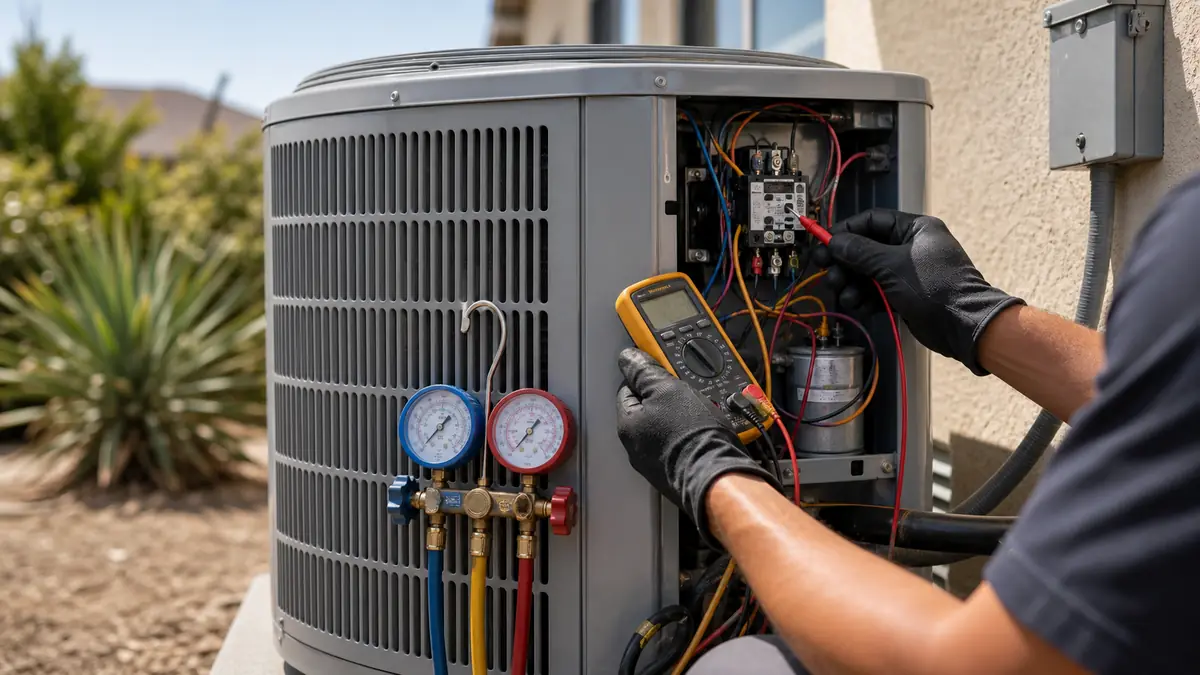
The walkthrough runs from cheap-and-external to expensive-and-internal, because condemning a compressor before ruling out airflow is how people overpay. First, instruments: a clamp meter on the compressor leads, a multimeter at the IPM, refrigerant gauges, and the unit's stored fault history pulled off the board. Second, read the history - did U6 fire once at 3 p.m. on the hottest day, or is it tripping on a mild morning? An afternoon-only pattern points at heat and airflow; an any-temperature pattern points at hardware. Third, check the outdoor side mechanically: spin the fan, confirm it runs at full speed, and inspect the coil - a coil caked with Canyon Country dust chokes heat rejection and spikes current, and a slow or dead fan does the same. Clean it and retest before going deeper. Fourth, put gauges on and read head pressure and subcooling; abnormally high head with a clean coil shifts suspicion to the metering device or overcharge. Fifth, meter the compressor windings for resistance and check for a winding short or ground; a healthy compressor reads balanced windings and no path to ground. Sixth, if windings are good and airflow is clean, the IPM board is the suspect - we check its output and look for a board that drives ragged or trips instantly on start. That order is the difference between a $500 fix and a $3,500 one.
| What we find | Likely cause | Cost lane |
|---|---|---|
| Dirty coil or slow/dead outdoor fan, high head | Airflow overload driving current up | $79 - $700 |
| Trips instantly on start, board drives ragged | Inverter / IPM power board | $400 - $2,000 |
| Shorted or grounded compressor windings | Failed DC inverter compressor | $1,200 - $3,500 |
| U6 only at peak afternoon heat, hardware checks clean | Marginal compressor near its limit | Monitor; plan replacement |
What can I safely check before calling a pro?
Stay on the outside of the cabinet and you can do real good. Turn the system off at the thermostat and pull power at the outdoor disconnect, then look: is the outdoor coil packed with dust, leaves, or cottonwood? A garden hose from the inside out, gently, on a de-energized unit clears a lot of what drives a heat-load U6 in this valley. Confirm there is real clearance around the condenser - if a fence or a row of bins sits within a couple feet of a Valencia side-yard unit, hot air is recirculating, and giving it room can be the whole fix. Change the indoor filter while you are at it. What you should not do: pull the electrical cover, meter the compressor, or keep cycling power to "see if it clears." U6 is an electrical overcurrent fault, the outdoor unit holds high-voltage DC on its capacitors, and forcing restart after restart drives more current through whatever is already faulting. Once the coil is clean and the unit still throws U6, that is the line - leave it off and book a tech with the meter and the certification to open it safely.
What does fixing a U6 cost in Santa Clarita?
It depends entirely on which of the three roots it is, and the spread is wide. If diagnosis lands on airflow - a dirty coil, a failed outdoor fan motor - you are in the $79 to $700 range, the best outcome and a common one here given the dust. If the inverter/IPM power board is driving the overcurrent, a board runs $400 to $2,000 installed depending on the model and outdoor unit. If the compressor windings prove shorted or grounded, a compressor replacement runs $1,200 to $3,500, and on a condenser that is already eight or ten years old that number is usually the moment to weigh a full replacement instead of pouring it into aging hardware. We do not guess between these. We meter the windings, read the board, and check airflow first, then quote the part we proved - because the difference between the cheap answer and the expensive one is thousands, and you deserve the real one. See the repair-or-replace briefing if the compressor is the verdict.
When is a U6 urgent?
Treat it as urgent during a heat wave and treat the restarts as the real danger. The code itself is the unit protecting the compressor, so a single U6 is not a fire-alarm. But two things make it pressing here. One, during a Santa Ana or a triple-digit stretch, a dead outdoor unit lets a two-story Saugus or Canyon Country home climb into the 90s indoors by mid-afternoon, which is genuinely unsafe for older residents, kids, and pets - we move true no-cool U6 calls to the front during heat spikes, and a morning slot beats an afternoon one. Two, every forced restart after a U6 drives current through a faulting circuit, which is exactly how a $500 board fix becomes a $3,000 compressor. So the urgent action is not to keep trying it - it is to shut it off and get it read. Set up service online or call, and if the diagnosis points at the compressor, look at AC repair versus replacement before you commit.
Common questions
Does a Mitsubishi U6 always mean a dead compressor?
No. U6 is the inverter reporting overcurrent, not a verdict on the compressor. About half the U6 calls we close out in Santa Clarita are the inverter/IPM power board mis-sensing or a bad outdoor fan loading the compressor, both far cheaper than a compressor. The point of diagnosis is to tell those apart before anyone quotes a $3,500 part.
Can I keep running my unit after a U6 code?
No, leave it off. U6 means the inverter cut the compressor on overcurrent to protect it. Forcing it to restart over and over drives more current through a compressor or board that is already faulting, which can turn a board-level repair into a compressor replacement. Kill power at the disconnect and book a diagnosis.
Why does my Mitsubishi throw U6 only in the afternoon heat?
Because heat raises head pressure, and head pressure raises compressor current. A marginal compressor or a board near its limit can run fine on a cool Valencia morning and trip U6 once Canyon Country hits 102 F. An afternoon-only U6 points us at heat-load and airflow first - a dirty coil or a weak outdoor fan - before condemning the compressor.
How much does a Mitsubishi U6 repair cost in Santa Clarita?
It splits two ways. If the fault is the inverter/IPM power board, figure roughly $400 to $2,000 installed. If diagnosis proves a failed compressor, it runs $1,200 to $3,500, and on an older condenser that pushes the repair-or-replace decision. We confirm the failed part with meter readings before quoting, so the number is the number.
Last updated 2026-06-13.