HVAC Sizing and Manual J in Santa Clarita, CA
The direct answer: Santa Clarita Mitsubishi HVAC sizes every system off a Manual J load calculation rather than the old unit's tonnage, and you can see how it works here, then call (213) 766-5980 or book online. Builder sizing across Valencia (91354) and Saugus (91350) was frequently a rule-of-thumb guess, and the SCV runs hotter today, so right-sizing shuts down short-cycling.
Snapshot
- Manual J is the trade-standard sizing method - a room-by-room heat-gain/loss accounting that correct sizing depends on.
- With Santa Clarita's design temperature running high, the cooling load steers the whole calculation.
- Oversized equipment buys you short-cycling, poor humidity control, and faster wear on the compressor and board.
- Builder tonnage was frequently a guess, and homes have changed since (windows, insulation, finished attics).
- Zone 9 puts a new split system through HERS refrigerant-charge and airflow verification, with duct sealing on any altered ducts.
- Correct sizing plus correct charge and airflow is what delivers a system's rated capacity.
Why is the old unit's tonnage the wrong starting point?
Because it was probably wrong then and is almost certainly wrong now. A lot of the original equipment in Santa Clarita's 1980s-2000s tracts was sized by rule of thumb - a rough square-footage formula that defaulted to "round up," which produced oversized systems across whole subdivisions. Even where the original sizing was reasonable, the home has changed: replacement windows, added attic insulation, a finished bonus room, new shade trees, or simply decades of the valley trending hotter all move the load. Replacing 4 tons with 4 tons just because that is what was there can lock in a mismatch you have quietly suffered for years - the upstairs that never cools, the unit that blasts and then quits. Sizing starts over from the house as it is today.
What does a Manual J actually measure?
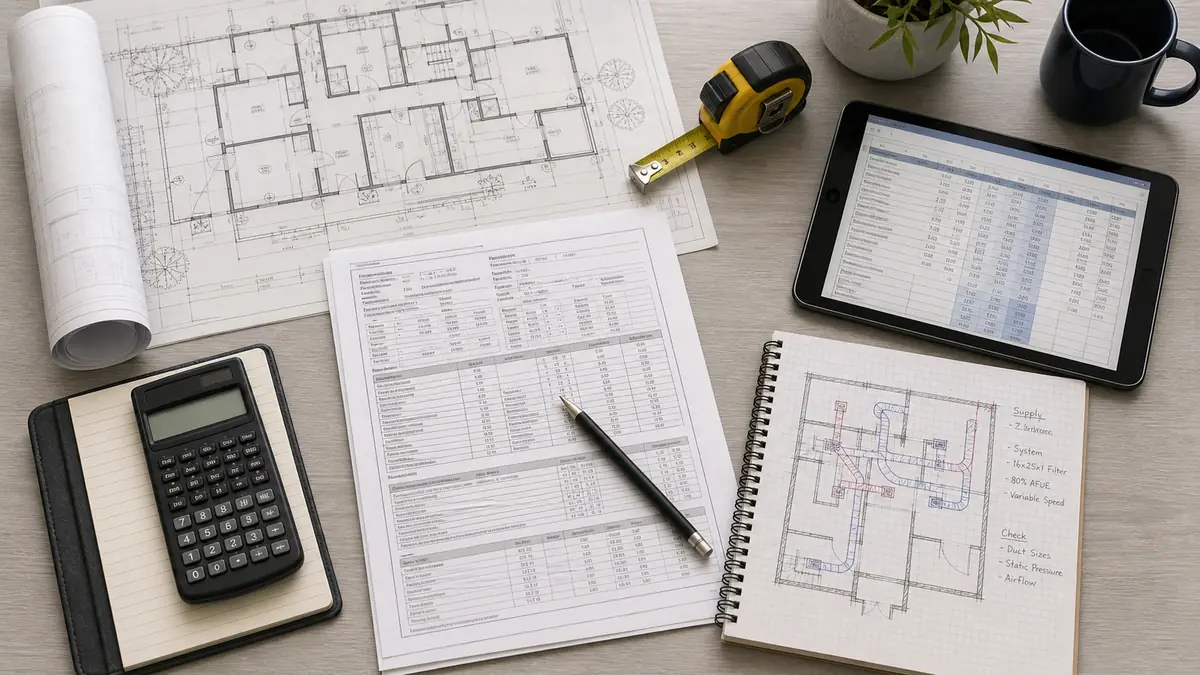
Manual J is the recognized standard for residential load calculation, and it works the house room by room instead of treating it as one undifferentiated box. The math takes in conditioned square footage and ceiling height, the area and orientation of every window (that south- and west-facing glass dumps real heat into a Santa Clarita afternoon), wall and attic insulation, air infiltration, the heat people and appliances throw off indoors, and the local design temperature. That last input is where the SCV splits from the coast: with Santa Clarita's summer design temperature sitting high, the cooling load drives the calculation. What comes out is an honest BTU/h cooling and heating requirement, which we convert into the right Mitsubishi capacity and, on a multi-zone system, the right division of capacity across rooms.
| Sizing approach | What happens in SCV heat | Result |
|---|---|---|
| Oversized (rounded up) | Cools fast, short-cycles, no humidity removal | Wear, high bills, uneven comfort |
| Undersized | Runs nonstop, cannot reach setpoint at 102 F | Discomfort, premature wear |
| Manual J right-sized | Long, gentle modulating cycles | Even comfort, efficient, durable |
Rule of thumb vs Manual J: a worked Santa Clarita example
Take a 2,000 sq ft two-story Valencia tract home. The old square-footage rule of thumb - roughly one ton per 400-600 sq ft - spits out 3.5 to 5 tons and, because installers round up to be safe, the builder dropped in 4 or 5 tons. A real Manual J for the same house often lands lower, near 3 to 3.5 tons, once it credits the dual-pane replacement windows the owner added, the upgraded attic insulation, and the shade from twenty years of grown trees - and once it stops pretending the upstairs and downstairs have the same load. The gap is the whole problem: a system sized a full ton or more over the real load is the short-cycling machine the rule of thumb keeps building. Manual J closes that gap by measuring instead of guessing. The same house might split as 1.5 tons downstairs and 1.5-2 tons upstairs on a multi-zone design, which the single-number rule of thumb can never see.
| Factor | Why it matters in the SCV |
|---|---|
| Window area and orientation | West- and south-facing glass dumps heat into a 100 F afternoon |
| Attic and wall insulation | Upgrades since the build cut the real load; rule of thumb misses them |
| Air infiltration / tightness | Leaky 1990s envelopes raise load; sealed retrofits lower it |
| Local design temperature | Santa Clarita's high summer design temp tips the calc toward cooling |
| Internal gains (people, appliances) | Kitchens and full bedrooms add measurable heat |
| Floor-by-floor split | Two-story homes need the upstairs load broken out, not averaged |
What is the oversizing failure chain?
The wasted dollars on the purchase order are only the start; in an SCV home an oversized unit kicks off a failure cascade. It drives the air to setpoint fast, so it shuts off before it has run long enough to pull humidity or even out room-to-room temperature. Minutes later the thermostat calls again, the compressor restarts, and the cycle repeats - short-cycling. Each restart is the hardest moment on a compressor and inverter board, so wear accelerates on exactly the parts that cost the most to replace. The bill climbs because start-up draws more current than steady running. Comfort drops because the rooms farthest from the thermostat never settle. And the inverter's headline advantage - smooth part-load modulation - is thrown away, because an oversized inverter reaches setpoint before it can ramp down and ride at the efficient low end. Right-sizing breaks the chain at its first link; no thermostat tweak or part swap further down can.
Why does right-sizing matter more for an inverter?
Because the whole advantage of a Mitsubishi inverter is modulation. Unlike an old single-stage unit that runs flat-out then shuts off, an inverter ramps its compressor up and down to match the load, holding a steady temperature and sipping power at part load. That only works if the equipment is matched to the load. Oversize it and the inverter never gets to ease up and down - it reaches the thermostat setpoint too quickly, short-cycles, and drains off the efficiency and comfort you paid for, all while wearing on the compressor and inverter board you least want to replace. Right-sizing is what lets the technology do its job. If your current system already short-cycles, the short-cycling page explains why no part swap fixes an oversizing problem.
How does sizing connect to multi-zone and ducted design?
On a multi-zone MXZ-SM system, Manual J does double duty: it sets total capacity and the per-room load, so we can pick head sizes (a 9k MSZ for a bedroom, a 18k for a great room) and make sure the outdoor unit is not over-committed across simultaneous zones. On a ducted SVZ/MVZ or P-Series system, the load calculation pairs with a static-pressure and duct-leakage check, because even a perfectly sized air handler cannot deliver its capacity through leaky or undersized 1990s ductwork. Title-24 enters here as well: in Zone 9, altering ducts requires duct sealing with HERS verification, and a new split system requires refrigerant-charge and airflow verification. Even sizing done right still rides on that charge and airflow being verified correct - skip the step and the rated capacity never reaches the rooms.
What should I expect during sizing?
We measure the home rather than eyeball it: square footage and ceilings, window areas and orientations, insulation, and duct condition where relevant. We use the Santa Clarita design temperature, run the Manual J, and present the resulting capacity with the Mitsubishi options that fit - single-zone, multi-zone, or ducted. You get a written sizing basis, not just a model number. From there, see the buying guide to compare systems, AC installation for the cooling path, or heat pump installation for an electrification conversion.
How is a multi-zone load split for a two-story tract home?
This is where Manual J earns its keep over a single tonnage number. On a two-story Valencia or Tesoro del Valle home, the upstairs and downstairs do not share a load - the upstairs takes roof heat gain and rising warm air, the downstairs sits cooler, and a single central system sized to the whole-house number almost always overcools one floor while losing the other. A room-by-room Manual J lets us assign capacity where it is actually needed: a great room with west glass might call for an 18k head, three bedrooms might each take a 9k, and the outdoor MXZ-SM is then chosen so it is not over-committed when several zones call at once during a heat spike. Get the per-room numbers wrong and you either starve a zone or oversize it into short-cycling, so the load split is not a formality - it is the design. The ducted air handlers page covers the alternative when good ductwork is worth keeping.
What happens when sizing is skipped on an SCV install?
You inherit a problem no warranty covers. The most common one we are called to "fix" is an oversized system that short-cycles - cools fast, quits, restarts - in a home where the previous installer copied the builder tonnage or rounded up from a square-footage table. There is no part to replace, because the equipment is simply too big for the load; the only real cure is a right-sized replacement, which is an expensive lesson in skipping a load calculation. The opposite failure shows up too: a system sized to a generic table that turns out undersized for a west-facing two-story Saugus home, running flat out and still losing the fight at 102 F. Both come from treating sizing as a formula instead of a measurement. A Manual J costs a little time up front and saves the much larger cost of comfort complaints, premature compressor wear, and, in the worst case, tearing a too-big system back out.
The bottom line on sizing a Santa Clarita system
- Never match the old tonnage on autopilot - the house and the climate have both changed.
- Insist on a Manual J load calculation, room by room, using the local design temperature.
- Expect cooling to drive the result in Zone 9; heating headroom is rarely the constraint here.
- On a two-story home, get the load split by floor so a multi-zone design can hold each setpoint.
- Pair sizing with the Zone 9 HERS refrigerant-charge and airflow verification, plus duct sealing on any altered ducts - rated capacity only reaches the rooms if charge and airflow check out.
- Ask for a written sizing basis, not just a model number, before you sign.
Common questions
Why not just match the tonnage of my old Valencia unit?
Because the old unit was often sized by rule of thumb, and your home is not the same as it was - new windows, added insulation, a finished attic, or just decades of the SCV running hotter all change the load. Replacing 4 tons with 4 tons can lock in an oversizing problem you have lived with for years. A Manual J starts fresh.
What is a Manual J load calculation?
Manual J is the load-sizing method the trade holds up as the standard - a room-by-room accounting of heat gained and heat lost. It accounts for floor area, ceiling height, how big your windows are and which way they face, insulation, air leakage, and the design temperature where you live. Because Santa Clarita's design temperature runs hot, the calculation here tips toward the cooling side.
Is bigger always better for a hot climate like the SCV?
Exactly the opposite. Oversize it and the unit cools the air fast, reaches the thermostat setpoint, and shuts off before it has pulled the humidity out or evened the temperature - then it fires back up, again and again. Size it correctly and it settles into longer, gentler cycles, which is the steady operation a Mitsubishi inverter is built around and runs most efficiently in.
Does HERS testing relate to sizing?
Indirectly, yes. Zone 9 rules have a HERS rater verify refrigerant charge and airflow on a new split system, and duct sealing too whenever the ducts get altered. Proper charge and airflow are what let a correctly sized system actually deliver its rated capacity, so the Manual J and the HERS check depend on each other - get the sizing right and you still throw it away if the charge or airflow is off.
Last updated 2026-06-13. Verify current Title-24 and HERS requirements for your climate zone and address.