Mitsubishi Error Codes in Santa Clarita, CA
The direct answer: A Mitsubishi error code in Santa Clarita, CA (ZIP 91350) is the inverter telling you which circuit tripped - P-codes flag indoor sensor or airflow faults, U-codes flag outdoor and compressor protection. Read the blink or controller code first, then call (213) 766-5980 or book online and we match it to the real fix.
Snapshot
- P-codes are indoor/protection faults (sensors, airflow, drain); U-codes are outdoor/inverter protection (compressor, board, discharge temp).
- Read the code three ways: wired controller screen, kumo cloud app, or the green OPERATION LED blink count on the head.
- SCV summers run hotter and drier than the LA basin, so heat-related U-codes (U2, U6) climb on 100 F-plus afternoons.
- A code that returns after a power reset is a real fault, not a glitch - have it read before parts get thrown at it.
- Service ZIPs: 91350, 91351, 91354, 91355, 91387, 91390. Hours: Weekdays 8am-7pm, weekends 9am-4pm.
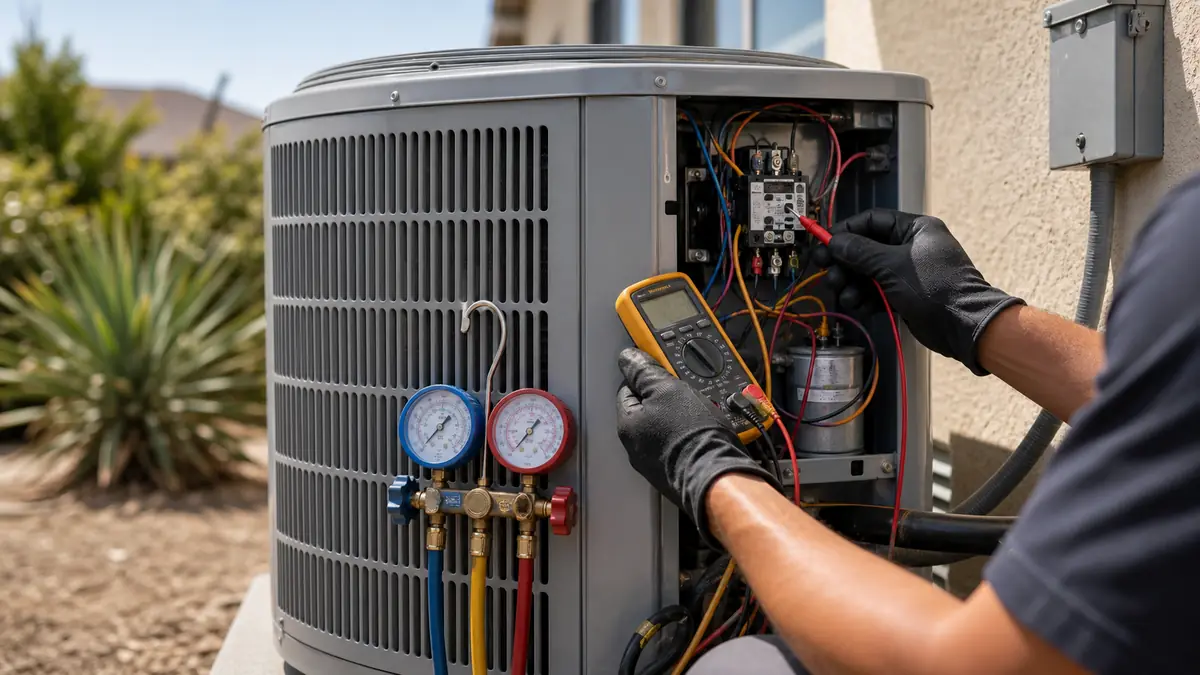
What do Mitsubishi error codes actually mean?
Mitsubishi Electric inverters self-diagnose. When a sensor reads out of range or a protection limit trips, the board stops the unit and posts a code rather than letting hardware cook itself. The letter tells you the neighborhood. P-codes (P1, P5, P6, P8) live on the indoor side and on protection logic - room and pipe thermistors, condensate, freeze and overheat limits. E-codes (E6, E7) are communication faults between the head and the condenser. U-codes (U2, U4, U6) are outdoor and inverter protection - discharge temperature, outdoor sensors, and compressor overcurrent. The number after the letter narrows it to a circuit. None of it is random, which is the point: a Mitsubishi tells you where to look before anyone opens a panel, and in a Santa Clarita Valley tract home where the condenser bakes on a west-facing side yard, that head start matters.
Which Mitsubishi codes show up most in Santa Clarita homes?
The Santa Clarita Valley sits above the LA basin with hotter, drier summers and bigger day-to-night swings, and that climate shapes which codes we see. Heat-load codes lead in July and August - U2 (high discharge temperature) and U6 (compressor overcurrent) climb when a condenser tucked against a Saugus zero-lot-line wall cannot dump heat into 104 F air. Airflow codes like P6 spike in spring when filters clog after a windy, dusty stretch off the high desert. Sensor codes such as P1 turn up year-round on heads in dusty Canyon Country rooms. The table below is the working chart we carry, with the most common real Mitsubishi codes, what each one means, and the first thing we check.
| Code | What it means | First check |
|---|---|---|
| P1 | Intake/room air thermistor (TH1) open or shorted | TH1 sensor and its plug at the indoor board |
| P5 | Drain pump abnormal / high condensate level | Clogged drain line, stuck float, dead pump |
| P6 | Coil freeze or overheat protection | Dirty filter or coil starving airflow; charge |
| P8 | Abnormal pipe temperature (often a refrigerant leak) | Pipe thermistor and flare-joint leak search |
| E6 / E7 | Indoor-outdoor communication error | S1/S2/S3 interconnect wiring and terminals |
| U2 | High discharge temperature, outdoor unit | Refrigerant charge, outdoor coil airflow |
| U4 | Outdoor thermistor open or shorted | Outdoor sensor harness and connectors |
| U6 | Compressor overcurrent sensed by the inverter | Inverter/IPM board, then compressor windings |
How do we read codes on a Mitsubishi here?
We read it the same three ways a homeowner can, then go past them. The wired MA or MHK controller spells the fault on its screen with the unit address. The kumo cloud app shows it under the affected zone if the adapter is installed. And the wall head flashes the green OPERATION LED in a counted pattern - we time the blinks and pair them with the indicator on the controller to confirm the P, E, or U code. From there the tech work starts: we pull the unit's stored fault history off the board, which tells us whether a U6 fired once on the hottest hour of the day or has been tripping for a week, and that history separates a heat-soak fluke from a failing compressor. On a multi-zone setup we identify which branch box port and which head threw the code, because a P1 on the Newhall bedroom head and a P1 on the living-room head are two different sensors. We confirm the model and the matched outdoor unit before quoting a single part.
How do we fix the codes once we read them?
Each family has its own path. Airflow P-codes (P6) usually clear with a filter, a coil cleaning, and a charge check - the cheapest lane, often inside a $79 to $200 visit. Drain faults (P5) mean clearing the condensate line or replacing a drain pump, $150 to $400. Sensor codes (P1, U4) come down to a thermistor or its harness, minor unless the indoor or outdoor board itself failed, $400 to $900 indoors. Communication faults (E6/E7) are a wiring and terminal repair first, $79 to $200, and a control board only if the wiring proves clean. The refrigerant-side codes (P8, U2) ride on a leak search and recharge to nameplate weight, $225 to $1,500. The expensive tier is inverter and compressor protection (U6, U2) - an inverter/IPM board $400 to $2,000, or a compressor $1,200 to $3,500, where the repair-or-replace decision enters on an older condenser. The two codes assigned most often to this brand here are the ones worth their own page.
What are the two codes we cover in depth?
Two Mitsubishi codes get a full diagnostic walkthrough on this site because they are the ones that strand a Santa Clarita home on a hot day and carry the widest cost spread. The first is the Mitsubishi U6 code - compressor overcurrent sensed by the inverter, a fault that can mean anything from an inverter/IPM power board mis-sensing to a genuinely failing compressor, with thousands of dollars between those two answers. The second is the Mitsubishi P1 code - an open or shorted intake (TH1) room thermistor that leaves the head guessing at room temperature, usually a cheap sensor but occasionally an indoor board. Read either of those pages for the step-by-step diagnosis, the homeowner-versus-pro line, and the local cost. For anything else, start with the chart above, then book service.
Is a coded Mitsubishi fault ever urgent?
Some are. A U6 or U2 during a Santa Ana heat event means the outdoor unit is protecting itself from a real electrical or refrigerant problem, and continuing to run it risks the compressor - we push those to the front during a heat spike. A P5 drain fault is urgent in a different way: it is the unit protecting your floor and ceiling from condensate, common on closet and attic air handlers in two-story Valencia infill, and ignoring it invites water damage. Communication and sensor codes are rarely emergencies but they will keep the system from cooling, which in a Canyon Country home that hits the 90s indoors by afternoon is its own problem. Read the code, do the safe airflow checks, and set up service online or call when it points past a dirty filter.
Common questions
Where do I see the error code on a Mitsubishi mini-split?
Read it three ways. The wired MA/MHK controller spells the code on its screen; the kumo cloud app shows it under the unit's status; and the wall head itself flashes the green OPERATION LED in a pattern. Match the blink count and the P/E/U letter to the chart on this page, then book the matching fix.
Can I clear a Mitsubishi fault code by cutting the power?
Sometimes the display clears, but the fault does not. Killing power at the disconnect resets the board and the code may not return until the unit reloads the same condition - a thermistor still open, a charge still low, an inverter still tripping. Treat a code that comes back after a reset as a real fault, not a glitch, and have it read.
Are Mitsubishi error codes the same on every model?
The common P, E, and U families are consistent across M-Series and P-Series Mitsubishi Electric equipment, which is why this chart travels. Exact wording shifts between a wall-mount MSZ head, a ducted air handler, and a multi-zone branch box, so we confirm the model and the connected outdoor unit before quoting any part.
Should a homeowner in Santa Clarita try to fix a coded fault?
Do the airflow basics only. Replace the filter, clear the outdoor coil, and confirm registers are open - that resolves many P-code airflow trips. Anything touching refrigerant, the inverter board, or the compressor needs gauges, a meter, and EPA certification, so book a tech once the easy checks are done.
Last updated 2026-06-13.