AC Repair in Santa Clarita, CA
The direct answer: Santa Clarita Mitsubishi HVAC handles AC repair across Santa Clarita, Valencia (91355), Saugus (91350), and Canyon Country (91351) - so call (213) 766-5980 or book online. We diagnose Mitsubishi Electric MUZ and MXZ inverter condensers plus builder central AC, read the P/E/U fault code, and quote on site, with most no-cool repairs landing between $150 and $1,500.
Snapshot
- Most common SCV no-cool cause: a worn run/start capacitor ($150-$450), which fails under peak afternoon head pressure.
- Refrigerant: legacy M-Series is R-410A (~$50-$80/lb installed); newer single-zone ducted P-Series uses R-454B.
- We read Mitsubishi P/E/U/F codes and the green-LED blink pattern before opening the unit.
- Diagnostic in the low-$100s, often credited toward the repair.
- Service area ZIPs: 91350, 91351, 91354, 91355, 91387, 91390. Hours: Weekdays 8am-7pm, weekends 9am-4pm.
- In-warranty Mitsubishi units referred to authorized service first.
Why is my Santa Clarita AC not cooling?
In the SCV the answer is usually electrical before it is mechanical. A dual-run capacitor that has drifted below spec is the number-one no-cool failure here, because the valley's 100 F-plus Santa Ana afternoons load the compressor harder than a mild morning, and a weak cap can no longer get it spinning. The next tier is a pitted or welded contactor, then a refrigerant leak, then the outdoor fan motor. On Mitsubishi inverter equipment, you also see protection shutdowns - the unit is fine but it tripped on a sensor or pressure fault and parked itself to avoid damage.
Because Mitsubishi systems are inverter-driven, they tell you a lot through the green operation LED and the code on the wired controller or kumo cloud app. We always read that first. A slow steady blink is often normal standby or defrost; a rapid patterned blink with the red timer LED is the unit flashing a fault. Counting the flashes or reading the app gives the exact P/E/U/F code, which keeps us from condemning a good compressor.
What do the Mitsubishi fault codes actually mean?
Roughly: P-codes are indoor sensors and protection, E-codes are communication and the remote controller, U-codes are the outdoor unit, compressor, and inverter, and F-codes are power and phase issues on three-phase P-Series. A U7 means low discharge superheat (low refrigerant). P8 is an abnormal pipe temperature that often signals a flare-joint leak. P4 and P5 are condensate drain and pump faults. U2, U3, U5, and U6 cluster around discharge temperature, the thermistor, the inverter heatsink, and compressor overcurrent. E6 through E9 plus EA/EB point at loose or corroded S1/S2/S3 inter-unit wiring - a frequent find on tract installs where the original line-set connections were never torqued well.
| Symptom / code | Likely cause / first check | Cost lane |
|---|---|---|
| Condenser hums, fan or compressor dead | Run/start capacitor, then contactor | $150 - $450 |
| Weak cooling, frost on coil, P8 / U7 | Flare-joint refrigerant leak; leak-search then recharge | $225 - $1,500 |
| Intermittent dropouts, E6-E9 / EA / EB | Loose or corroded S1/S2/S3 inter-unit wiring | $150 - $600 |
| Outdoor unit trips on startup, U2 / U5 / U6 | Inverter PCB / IPM, then DC compressor | $400 - $3,500 |
| Water under indoor head, P4 / P5 | Clogged condensate drain or failed drain pump | $95 - $450 |
| Outdoor fan dead, condenser hot, U8 | Outdoor DC fan motor or its driver on the PCB | $300 - $900 |
| Over/undervoltage trip, U9 on a Santa Ana spike | Supply voltage, then inverter power board | $200 - $2,000 |
How does a Santa Clarita AC repair visit actually go?
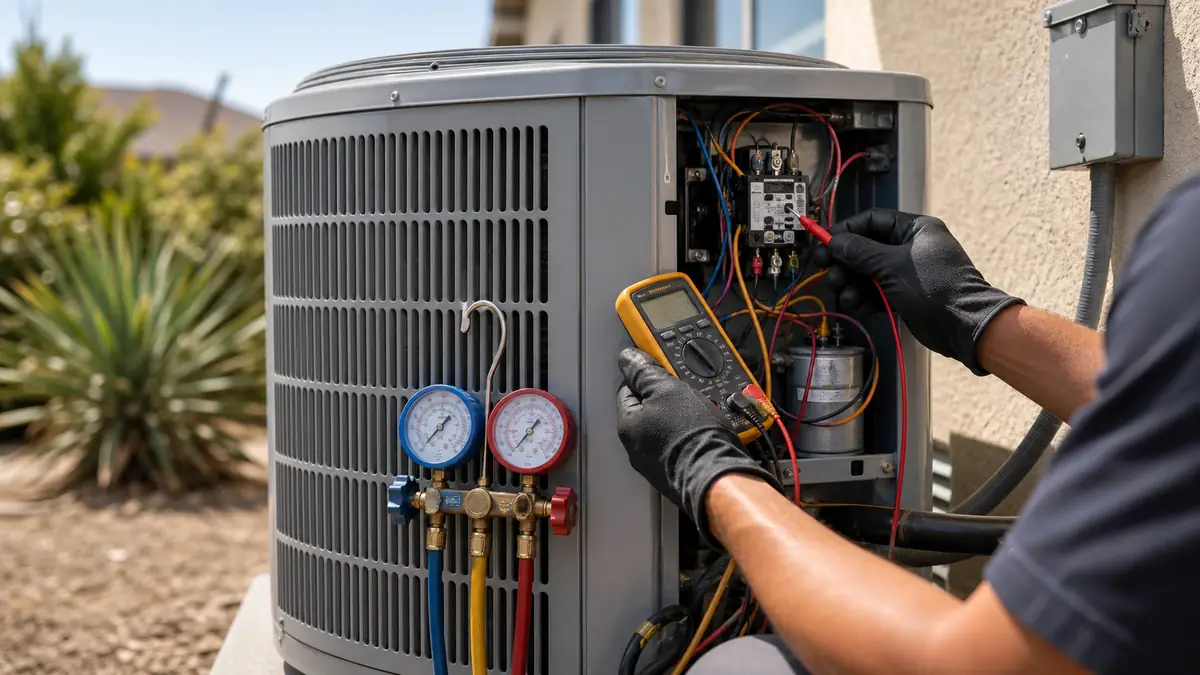
Start to finish, an inverter no-cool call runs through five steps. First the read: before a panel comes off, we count the indoor green-LED blink and pull the alphanumeric code from the wired controller or kumo cloud app, because a U6 versus a P-code sends us to completely different parts. Second, the electrical check at the condenser - a clamp meter on compressor and fan amp draw, a capacitor meter on the dual-run cap's microfarads, and a look at the contactor for pitted or welded points; in SCV heat the cap is the number-one find. Third, the refrigerant side if the code or the frost pattern points there - gauges on the service ports, superheat and subcool math, and an electronic leak detector or nitrogen pressure test walked along the flare joints, since flares are where ductless line sets leak. Fourth, the fix: a cap or contactor swap on the spot, a flare reseal and recharge to the nameplate weight, an S1/S2/S3 terminal re-torque, or a board/compressor quote if the inverter is the failure. Fifth, verification - we restart, watch the unit ramp through its inverter curve, confirm the supply-air split and the absence of the original fault code, and hand you a written summary.
Which Mitsubishi lines does this cover?
All the M-Series gear in SCV homes plus the larger P-Series. What differs for repair is the refrigerant and the board: legacy M-Series is R-410A (about $50-$80 per pound installed), while the newest single-zone ducted P-Series (PUZ-AK..NLHZ with PEAD-AA..NL) runs R-454B and needs different gauges and recovery handling. Inverter condensers also fail more on the power board and IPM than on the brute capacitor-and-contactor faults of the older single-stage central units a few homes still run - so the diagnosis differs by what is actually in your side yard.
- MSZ wall heads (MSZ-WR, MSZ-HM, MSZ-GL, MSZ-FS): the indoor side, where P-codes dominate - condensate (P4/P5), thermistor drift (P1/P2/P9), filter/coil airflow (P6), and on the FS the 3D i-see occupancy sensor. The cooling failure here is usually a frozen coil from low charge or starved airflow, not the head itself.
- MUZ single-zone condensers (MUZ-WR, MUZ-HM, MUZ-FS): the outdoor side - run/start capacitor, contactor, DC fan motor, inverter PCB, and compressor; U-code territory (U2/U5/U6/U8). This is where most SCV no-cool calls actually land.
- MXZ / MXZ-SM SMART MULTI multi-zone: when one zone cools weak but the rest are fine, the fault is usually that branch's LEV or a line-set leak, not the shared condenser; all zones down points back to the outdoor unit.
- MFZ-KJ floor consoles and MLZ ceiling cassettes: same fault language as the wall heads with their own low-cabinet drain routing, so P4/P5 cluster here.
- Ducted SVZ/MVZ and P-Series PEAD/PVA on PUZ outdoor units: add the ECM blower motor to the failure list ($450-$2,300), and on the newest single-zone ducted P-Series, R-454B recovery handling.
What does an AC repair cost in Santa Clarita, and why?
The diagnostic itself sits in the low-$100s (SoCal commonly around $139) and is often credited toward the repair if you approve the work that day. From there the job splits by sub-task. A capacitor or contactor is $150-$450 - the part is cheap, the cost is the trip and labor. A refrigerant leak repair plus recharge runs $225-$1,500, driven by where the leak is (a reachable flare reseal is cheap; a buried line-set or coil leak is not) and how much R-410A the system holds. An inverter power board is $400-$2,000 because the Mitsubishi PCB part alone often runs $120-$800-plus. An inverter DC compressor is $1,200-$3,500, and that is the number that usually tips a 12-to-15-year-old condenser toward replacement instead. SCV labor and permitting run above the national average, and a Santa Ana heat event stacks demand, so booking early in the day on a spike weekend gets you seen sooner.
How fast can you get to a no-cool call?
We hold same-week service and triage true no-cool calls ahead of routine maintenance, because a dead condenser in a two-story Saugus or Canyon Country tract home pushes indoor temperatures into the 90s by mid-afternoon on a 100 F-plus Santa Ana day - genuinely unsafe for older residents, infants, and pets. To get seen fastest, book early in the day on a heat-spike weekend, when the valley peaks and calls stack up across all six service ZIPs. Have two things ready when you call: the model number off the outdoor MUZ/MXZ data plate and any P/E/U code on the controller or kumo cloud app, so we can stage the likely parts - a dual-run capacitor, a contactor, an outdoor DC fan motor - on the truck and often close the no-cool in one visit. You can set up service online or call (213) 766-5980.
When does an AC repair become a replacement?
The line is the cost of the failed part against the age of the condenser. A capacitor, contactor, fan motor, drain pump, or thermistor on a 10-to-15-year-old unit is always worth fixing - the part is cheap and the system has years left. The decision flips when the quote is an inverter board ($400-$2,000, the Mitsubishi PCB alone often $120-$800-plus) or an inverter DC compressor ($1,200-$3,500) on a condenser already past 12-15 years. At that point the repair runs toward half the price of a new right-sized system, and a sunset unit will likely throw the next big-ticket fault within a season or two. A replacement also resets the warranty clock, lifts the cooling efficiency from a worn R-410A unit toward 18-plus SEER2, and qualifies for LADWP or SCE rebates a repair cannot claim. We put both numbers in front of you in writing before you decide. Read the repair-or-replace briefing for the worked math, or if cooling is gone entirely start with the AC-not-cooling walk-through.
Common questions
Why does my Valencia AC quit only on the hottest afternoons?
That pattern usually points at a weak run capacitor. As the dual-run cap loses microfarads, it still starts the compressor on a mild morning but cannot under the higher head pressure of a 102 F Santa Ana afternoon. It is a $150-$450 fix and the single most common Santa Clarita no-cool cause.
What does a P8 code mean on my Mitsubishi head?
P8 flags an abnormal pipe temperature, which on a wall unit very often means a refrigerant leak - typically at a flare joint on the line set. Topping off without finding the leak just delays the next failure, so we leak-search first. Repair and recharge runs roughly $225-$1,500 depending on where the leak is.
Is it cheaper to recharge refrigerant than fix the leak?
No, and a recharge alone is a band-aid. R-410A runs about $50-$80 per pound installed, and a system low on charge has a leak by definition. We find and seal the leak, then recharge to the nameplate weight, so you are not paying for refrigerant that vents out again by next summer.
My condenser is under warranty - should I still call you?
If the Mitsubishi outdoor unit is inside its parts-and-labor warranty, take it to manufacturer-authorized service first; that is the honest call and it saves you money. Once it is out of warranty, or for the central condenser and furnace the builder added, we are your independent option.
My Mitsubishi head is icing over in summer. Is that low refrigerant?
Often, yes. Ice on the indoor coil in cooling mode usually means low charge from a flare leak (watch for a P8 or U7) or restricted airflow from a clogged filter or dirty coil. Both starve the coil of heat and let it freeze. We thaw it, find the real cause, and fix that rather than just hosing it off.
Can a power surge from a Santa Ana outage damage my inverter board?
It can. The SCV's grid takes hits during Santa Ana wind events, and an over/undervoltage swing can trip a U9 or, worse, fry the inverter PCB. If your unit died right after an outage and will not restart, we check supply voltage first, then the power board. A surge protector at the disconnect is cheap insurance afterward.
Last updated 2026-06-13.